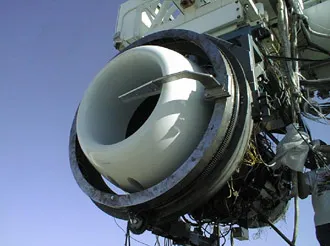
3 min read Preparations for Next Moonwalk Simulations Underway (and Underwater) To measure airflow and sound, research teams at the NASA Glenn Research Center use special instrumentation like particle image velocimetry, hot wire anemometry, Raman spectroscopy, microphones in phased arrays or continuously rotating rakes. The global aviation noise reduction community relies on data from NASA GRC experiments to validate theory and noise prediction software. Rotating Rake Mode Measurement System (RRMS) Hear an annoying tone from your turbofan engine? Engineers might prescribe an advanced liner or specially tuned active noise control system to quiet it down. To get it right, though, more information about the modal content of the tone is needed. This kind of data can’t be measured with a stationary microphone, which is why NASA Glenn engineers pioneered procedures using rotating microphones in the 1990s. Rotating Microphone Rakes have been used by NASA Glenn researchers in a wide variety of tests ranging from low-speed proof of concept tests in the Advanced Noise Control Fan Rig and 9- by 15-Foot Low Noise Wind Tunnel to full-scale turbofan engine ground tests. Rotating Rake Mode Measur
No comments yet.
Log in or sign up to comment.